Overview
Boride Engineered Abrasives manufactures abrasive products for industrial and consumer use, including polishing stones, mounted points, coated abrasives, air grinders, and sharpening stones.
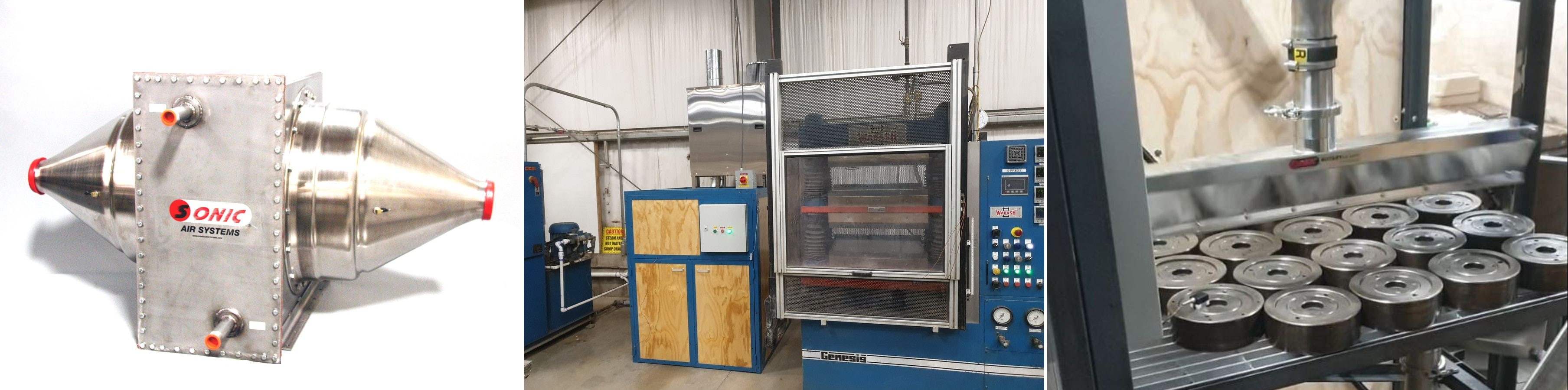
Boride's steel mold tooling requires a range of round mandrels up to 8.25 inches (21 cm) in diameter. Assorted abrasives and adhesives are layered onto each mandrel to form the finished products. Every 3 to 4 forming cycles, batches of 10 to 20 mandrels, weighing 290 to 360 lb (132 to 163 kg) per batch, run through a 400°F (204°C) oven to burn the mandrels clean before the next batch of products is formed.
Before forming can resume, the mandrels must cool below 100°F (38°C). Boride's original setup, a low-pressure fan blowing sub-40°F (4°C) outside air into an enclosed mandrel cooling chamber, took about 40 minutes per batch, well short of the 20-minute target needed to keep pace with daily production.
Solution
In 2020, Boride evaluated several compressed air cooling options. Each could have done the job, but all of them required adding a dedicated 50 HP compressed air system to run. After contacting Sonic Air Systems, Boride installed a Sonic 7.5 HP blower powering multiple patented Sonic Rotary Air Knives in November 2020.
That first winter, the high-velocity air from the Sonic system, combined with Michigan's cold ambient temperatures, brought cooling cycles below the 20-minute goal. The following spring, once warmer ambient air could no longer cool the mandrel batches in under 20 minutes, Boride added a Sonic COOL-AIR™ in-line air-to-water aftercooler. Feeding air below 50°F (10°C) into the rotating air knives, using Boride's existing chilled water circuit at 18 GPM, the COOL-AIR™ aftercooler kept every batch of mandrels within the 20-minute cooling window, even during summer ambient temperatures up to 90°F (32°C).
Result
Sonic's rotary air knives and in-line COOL-AIR™ aftercooler deliver full coverage with uniform air velocity across each batch of mandrels. The engineered cooling solution eliminated the bottleneck that had been holding back production, improving both throughput and consistency.