In this article
- What Is Air-Impingement Cooling?
- How Air Impingement Cooling Compares to Conventional Methods
- Airflow and Velocity Requirements
- Where Sonic Cold Air Blowers and Air Knife Cooling Systems Have Been a Proven Success
- Air Impingement Cooling System Design Considerations
- Sonic Air Systems and High Velocity Air Impingement
When a part comes off a machining line, out of a forming press, or through a surface treatment process, temperature is often the variable that controls what happens next. Cooling too slowly can distort tolerances, compromise surface finish, or create bottlenecks that limit line speed. Cooling with the wrong method can introduce contamination, cause uneven thermal gradients, or simply fail to deliver enough heat transfer at the throughput speeds modern facilities require.
High velocity air impingement cooling can address many of these problems directly. It is one of the most effective and efficient non-contact cooling methods available for industrial manufacturing, and it is widely used in automotive, metal finishing, and plastics production. This article covers how the process works, how it compares to conventional cooling methods, the airflow and velocity requirements that make it effective, and the specific manufacturing scenarios where it performs best.
What Is Air-Impingement Cooling?
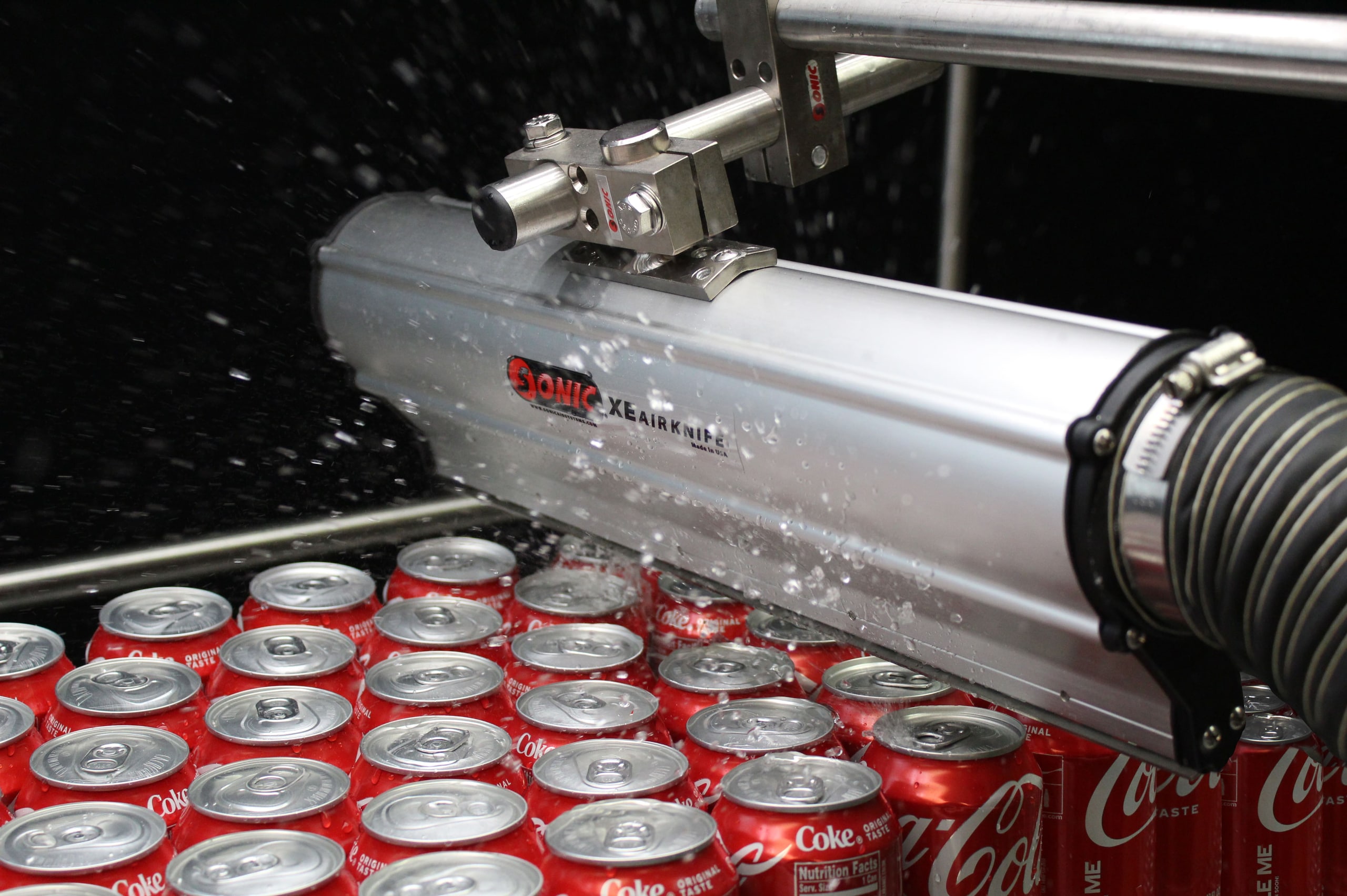
Air impingement cooling uses focused, high-velocity streams of air directed perpendicular to a product surface. The air is delivered through nozzles or air knife systems positioned to deliver enough impact air at close range, and the velocity of impact is what drives the heat transfer rate.
The underlying physics are straightforward. When still or slow-moving air contacts a hot surface, a thin boundary layer of warmer air builds up around the part and acts as an insulator, reducing the rate at which heat can transfer away from the surface. Enough impingement velocity disrupts that boundary layer continuously: high-velocity air jets break through it, carry heat away, and constantly replace the air at the surface with cooler, faster-moving air. The result is a substantially higher convective heat transfer coefficient than any form of passive or low-velocity air cooling can achieve.
The defining variables are air temperature and impact velocity. In industrial air impingement systems, exit velocities at the nozzle or knife outlet commonly reach 20,000 to 30,000+ FPM. At those velocities, the impact force and convective exchange rate are high enough to cool parts rapidly without contact and without the process contamination risks that other methods can introduce.
How Air Impingement Cooling Compares to Conventional Methods
Still-Air and Fan-Based Cooling
The simplest cooling approach is ambient still-air or low-velocity fan cooling. For parts with minimal thermal mass or long cycle times, this can be adequate. But fan-based cooling delivers low and sometimes inconsistent air velocity across a part surface, where the boundary layer effect is significant. Heat transfer rates are slow, and throughput limits follow directly from that.
In high-speed production environments, fan cooling either requires long cooling zones that consume floor space or it simply cannot keep pace with line speed. It also provides no control over where cooling is applied, which can cause uneven temperature profiles across complex part geometries.
Liquid Cooling and Water Quench
Water quench and liquid cooling deliver much higher heat transfer rates than air-based methods, and they remain the right choice for processes requiring extreme or rapid temperature drop. But they introduce their own constraints: many types of parts must then be dried using a Sonic air knife system before the next downstream processing step, and the risk of product quality issues from residual water left on a product, along with the cost to remove it, can be significant.
For processes where surface cleanliness matters, where drying adds cycle time, or where coolant contact with the part material is a problem, air impingement cooling is the cleaner solution. It delivers high heat transfer rates while keeping the process dry and contamination-free.
Compressed Air Systems
Compressed air is often used for a few key benefits, which are soon realized to come with some significant downsides.
On the plus side, the rapidly expanding compressed air at the exit of nozzles and air knives cools quickly and reduces the compressed air's humidity. The lower purchase cost of compressed air nozzles and knives, since central air compressor systems are often already in place, can make compressed air a quick, inexpensive way to test cooling effectiveness, or a long-term option when air cooling is only needed infrequently and for short periods. The piping and hoses supplying compressed air nozzles and knives are typically 1 inch in diameter or smaller.
Among the drawbacks of using compressed air for cooling: operating compressor motor power demand can run 50 to 75 percent higher than a blower-powered air knife cooling system, and compressed air filtration, oil, and condensate removal often need to be upgraded to handle the higher flows that cooling requires. Compressor maintenance frequency increases with higher and more continuous air flow, and other factory demands for compressed air can suffer from a system-wide drop in pressure and flow.
Centrifugal Blower-Driven Air Knife and Nozzle Systems
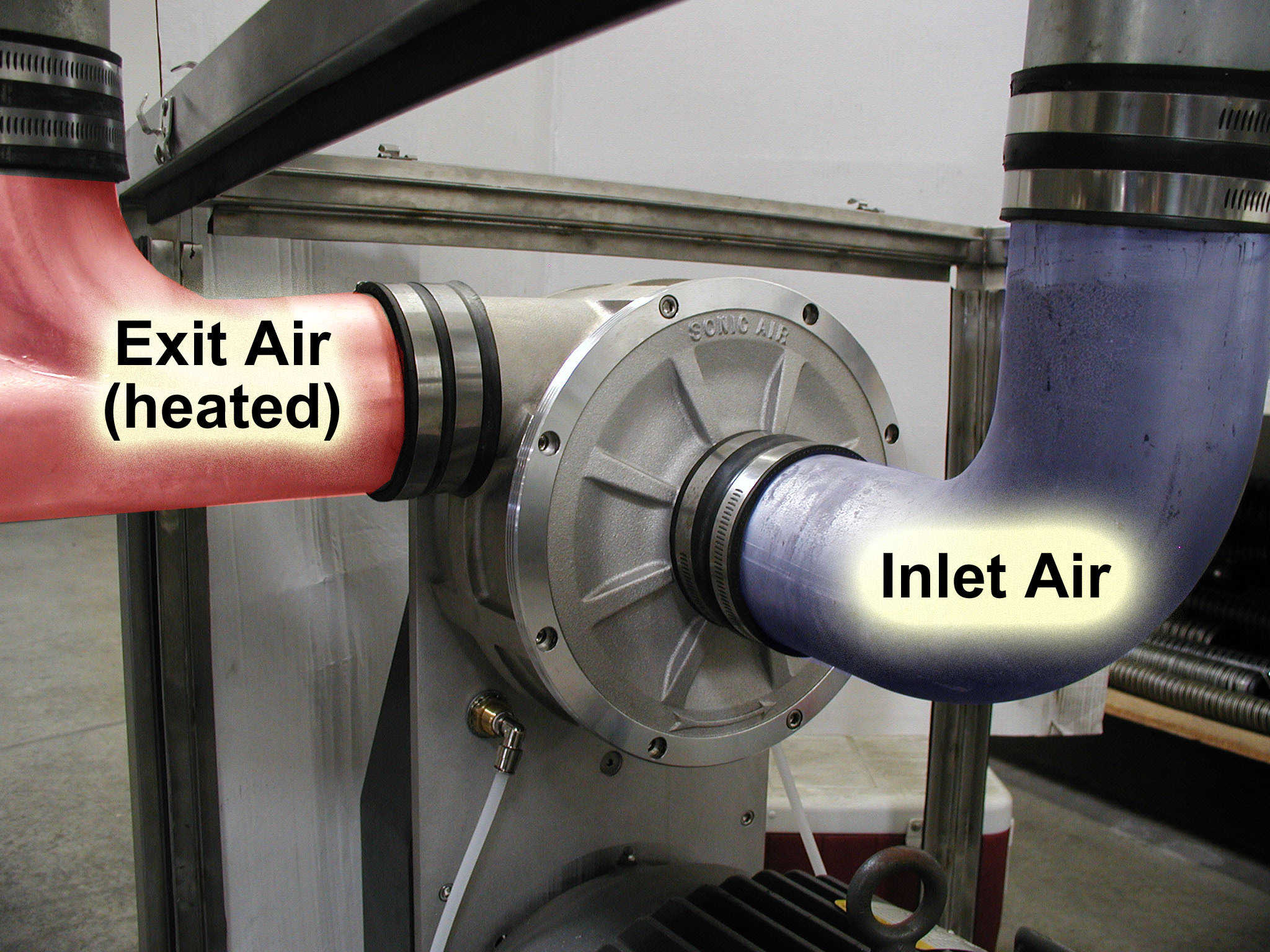
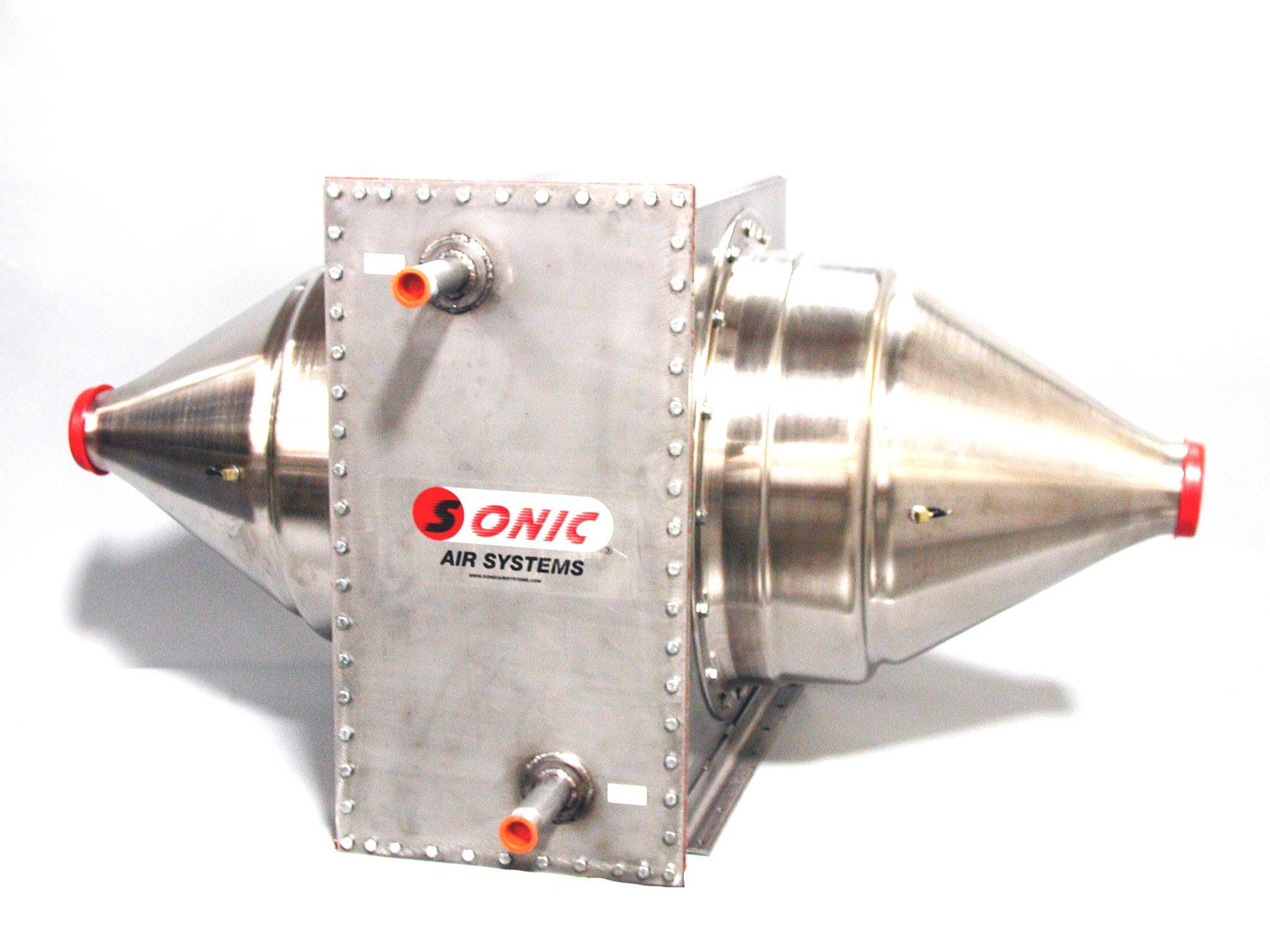
With either high air velocity at 40-45°F above ambient air temperatures, or blower air with an in-line aftercooler to deliver air temperatures down to 10°F above freezing, both options can be tailored to the customer's cooling parameters. Blower-powered product cooling systems are designed to provide an effective and energy-efficient alternative to compressed air cooling, where few options have existed before.
As with virtually every other application where blower-powered air nozzles and air knives have proven equal, and in most cases superior, to the decades-long habit of defaulting to compressed air, blower-powered cooling air nozzles and air knives have become the modern cooling method of choice. Adopting a higher-CFM, lower-pressure blower system does require larger diameter supply piping and hose assemblies, typically 3 and 4 inches in diameter, compared to the 1 inch and smaller lines used for compressed air. Most facilities have ample room for the larger piping and air knives, which are easy to justify given the advantages of blower-powered air cooling: 50 to 75 percent lower energy demand, higher air volumes that let multiple air knives sustain cooling over a longer duration, in-line high-flow blower after-coolers (using a cooling tower or chilled water for maximum air cooling), and engineered systems tailored to each application's challenges. Of course, many products and cooling applications need nothing more than natural blower temperature and air knife velocity to achieve the required temperature reduction, without an after-cooler at all.
Centrifugal blower-driven air knife and nozzle systems hold velocity much better at distance.
Airflow and Velocity Requirements
Effective air impingement cooling requires enough airflow volume to sustain the cooling effect continuously across the part surface, and enough exit velocity to break through the boundary layer and deliver meaningful convective exchange. These two variables interact, and system design has to account for both.
For most industrial cooling applications, exit velocities in the range of 20,000 to 30,000+ FPM are the effective operating zone. Below 20,000 FPM, the boundary layer disruption effect decreases and heat transfer rates drop. Above 30,000 FPM, the incremental gains in heat transfer are smaller, while energy consumption and noise increase.
Nozzle-to-surface distance has a significant effect on impact velocity, which is why compressed air systems underperform at real working distances. Centrifugal blower systems using properly designed air knives or multi-nozzle manifolds maintain usable velocity over greater distances, which matters in applications where parts cannot be positioned immediately adjacent to the air outlet.
The geometry of the part also drives system design. Flat, continuous surfaces like strip metal or flat sheet goods are well-served by linear air knives delivering a curtain of high-velocity air across the full product width. Complex geometries with blind holes, recesses, and undercuts require swivel nozzles or multi-axis manifolds that can direct impingement air into cavities that a linear knife cannot reach.
Where Sonic Cold Air Blowers and Air Knife Cooling Systems Have Been a Proven Success
- Steel Parts After Burn-Off Oven
- High-Speed Electric Power Generators
- Mixed Aggregate Batching
- Post Heat Treating of Various Products
- Various Polymer Webs After Thermal Treatment or Bonding
- Workpieces After Plasma Coating or Cutting
- Fabricated Metal Parts After Welding
- Applications Where Thermal Shock Must Be Avoided For example, Boride Engineered Abrasives needed to cool steel mold mandrels below 100°F within a 20-minute window after a 400°F burn-off oven. Sonic rotary air knives with an in-line COOL-AIR™ aftercooler cut their cooling cycle in half. Read the Boride case study.
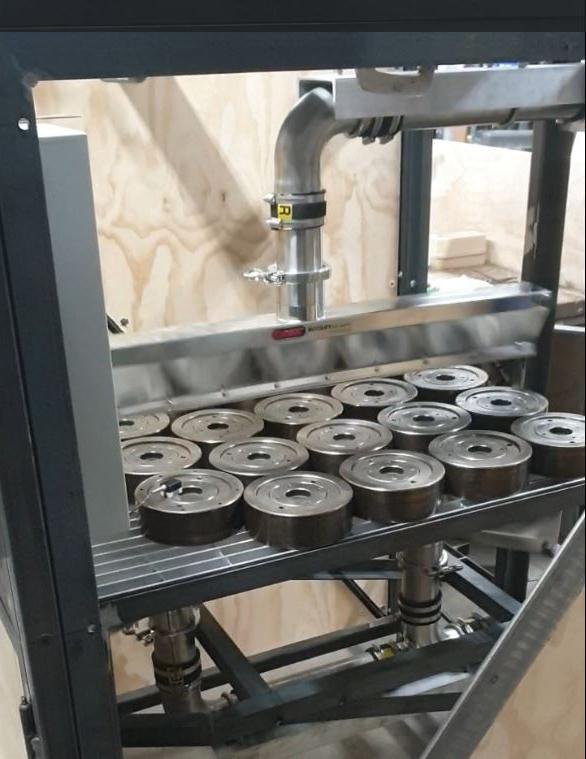
A Sonic Rotary Air Knife cooling a batch of steel mandrels at Boride Engineered Abrasives.
A similar approach shows up in solar panel manufacturing, where centrifugal blowers power cooling jackets around vacuum furnace walls to speed cool-down between high-temperature PV cell batches. Read the case study.
Air Impingement Cooling System Design Considerations
Selecting and sizing an air impingement cooling system requires working through several interrelated parameters, including:
- Required heat extraction rate, which depends on part material, mass, incoming temperature, and target exit temperature
- A time-vs-temperature profile under natural temperature radiation conditions
- Line speed and cycle time, which determine how much cooling time is available in the zone
- Part geometry, including surface access, blind features, and the range of product sizes or configurations the system needs to handle
- Any specific surfaces or areas where target temperatures matter most
- Nozzle-to-surface distance, which affects impact velocity and coverage uniformity
- Environmental conditions and constraints, such as ambient temperature range, noise level limits, enclosure requirements, or process contamination concerns
One of the consistent findings across industrial installations is that the specific geometry of air delivery matters as much as raw airflow volume. A correctly positioned air knife with an engineered gap profile will outperform a higher-volume system with poor nozzle placement. The right combination of blower, after-cooler, and air knife system components and accessories makes that level of precision possible.
Sonic Air Systems and High Velocity Air Impingement
Sonic Air Systems has designed and supplied centrifugal blower-powered air knife and nozzle systems for high velocity impingement applications across automotive, metal finishing, plastics, and other manufacturing industries. Systems range from 10 HP to 50+ HP, with air knife exit velocities consistently in the 20,000 to 30,000+ FPM range across product lines.
Every application starts with a technical review of the process requirements before any system is specified. Part geometry, production rate, upstream and downstream process constraints, and the facility environment all factor into the system design. The result is an engineered solution sized for the specific application rather than a generic blower-and-knife package.
If your process requires high velocity air impingement cooling or blow-off, contact Sonic Air Systems to discuss your application. You can contact the engineering team or call (714) 255-0124.